- This topic is empty.
-
AuthorPosts
-
2026-05-18 at 3:54 pm #13541
Liquid Silicone Rubber (LSR) has become one of the most important advanced elastomer materials in modern engineering. Known for its exceptional thermal stability, chemical resistance, electrical insulation properties, and long-term durability, LSR is widely used across demanding industries where reliability is non-negotiable.
Among these sectors, aerospace and high-tech industries represent the most challenging environments for materials science. Components must perform under extreme temperatures, vacuum conditions, radiation exposure, vibration, and long service lifetimes. In such conditions, traditional polymers often fail, while Liquid Silicone Rubber continues to deliver stable performance.
This article explores the critical role of Liquid Silicone Rubber in aerospace and high-tech applications, highlighting its material advantages, key use cases, engineering benefits, and future development trends.
What Makes Liquid Silicone Rubber Unique?
Liquid Silicone Rubber is a two-part platinum-cured elastomer that is typically processed through injection molding. Unlike conventional rubbers, LSR is highly purified and designed for precision manufacturing.
Its unique molecular structure gives it a combination of properties that are especially valuable for aerospace and high-tech systems:
1. Extreme Temperature Resistance
LSR can typically withstand temperatures ranging from -60°C to 200°C or higher, depending on formulation. This makes it suitable for both the freezing conditions of space and the heat generated by electronic or propulsion systems.
2. Outstanding Flexibility and Elasticity
Even at low temperatures, LSR maintains elasticity without becoming brittle. This is critical for sealing systems exposed to thermal cycling.
3. Excellent Chemical and Environmental Resistance
LSR resists oxidation, UV radiation, ozone, fuels, and many aggressive chemicals, ensuring long-term stability in harsh environments.
4. Electrical Insulation Properties
With high dielectric strength and stable performance across temperature ranges, LSR is widely used in electronic insulation components.
5. Low Outgassing Characteristics
In aerospace environments, materials must minimize volatile emissions. LSR’s low outgassing properties make it suitable for vacuum and space applications.
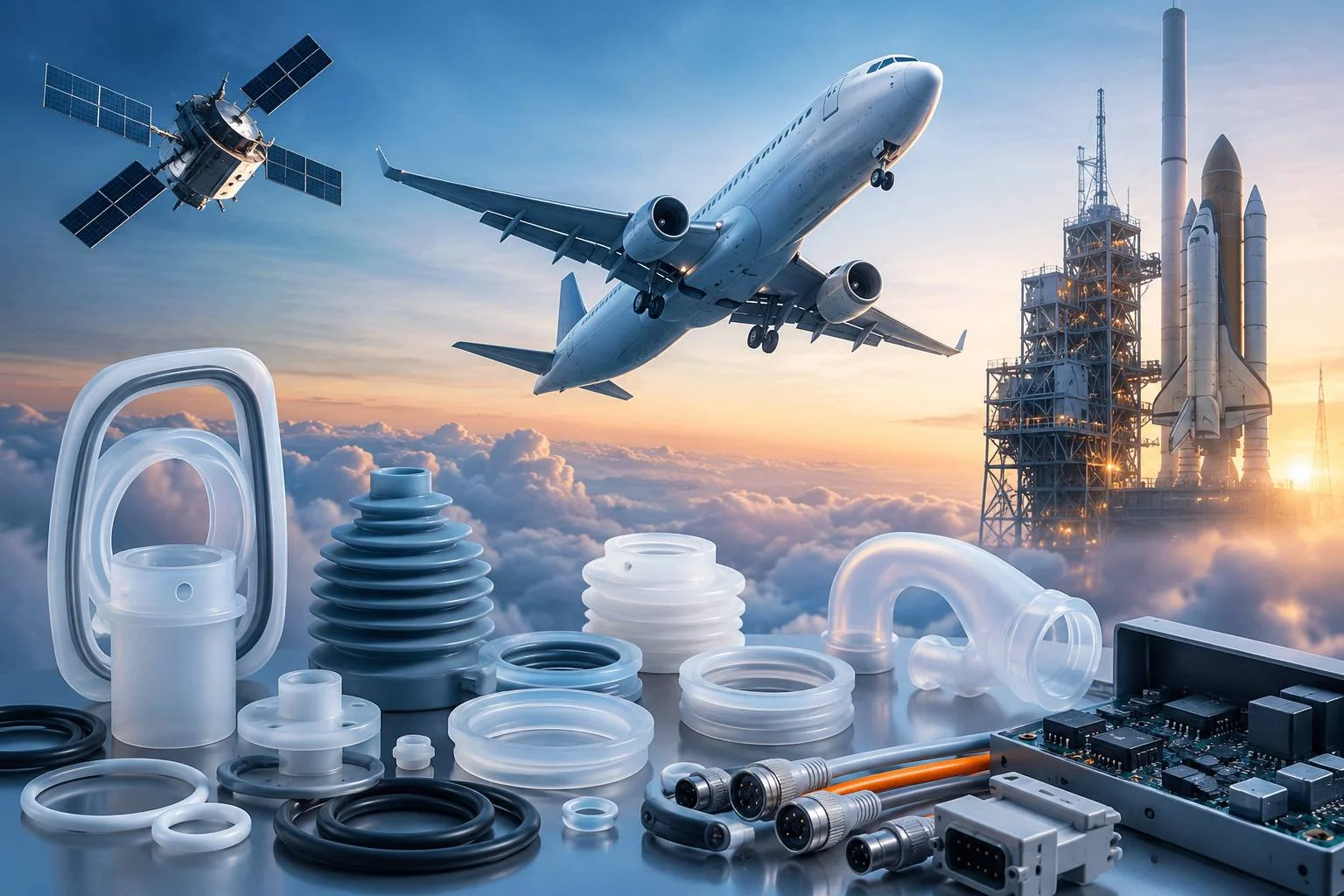
Why Aerospace Industry Relies on Liquid Silicone Rubber
The aerospace industry demands materials that perform flawlessly under extreme conditions. Every component must meet strict safety, reliability, and weight requirements.
Liquid Silicone Rubber plays a critical role in meeting these demands.
1. Sealing Systems in Aircraft and Spacecraft
LSR is widely used in seals, gaskets, and O-rings in aircraft cabins, engines, and fuel systems. These components must maintain airtight and fluid-tight seals under pressure changes and extreme temperatures.
In spacecraft, LSR seals are even more critical due to vacuum exposure. Any leakage or degradation can lead to system failure.
2. Vibration and Shock Absorption
Aircraft and spacecraft experience continuous vibration and mechanical stress. LSR components are used as damping materials to reduce vibration impact on sensitive equipment such as avionics systems and navigation instruments.
3. Thermal Protection and Insulation
In aerospace applications, LSR is often used as thermal insulation material to protect electronic components and wiring harnesses from heat generated by engines or atmospheric friction.
4. Fuel and Fluid System Compatibility
LSR’s chemical resistance allows it to be used in fuel system seals and hydraulic systems without degradation, ensuring long-term reliability.
Liquid Silicone Rubber in Space Exploration
Space environments present some of the harshest conditions known to engineering. Materials must survive radiation exposure, extreme temperature fluctuations, and vacuum conditions.
LSR is widely used in:
1. Satellite Components
Seals, connectors, and protective coatings made from LSR ensure satellite systems remain operational for years without maintenance.
2. Spacecraft Electrical Systems
LSR is used for insulating wires, connectors, and sensor housings due to its stable dielectric properties.
3. Extraterrestrial Equipment
Robotic systems and exploration tools rely on LSR components for flexibility and durability in unpredictable environments.
One of the key advantages is that LSR does not become brittle in cold space environments, unlike many conventional elastomers.
Role of Liquid Silicone Rubber in High-Tech Industries
Beyond aerospace, LSR plays a vital role in multiple high-tech sectors, including electronics, medical devices, robotics, and renewable energy systems.
1. Electronics and Semiconductor Industry
As devices become smaller and more powerful, thermal and electrical management becomes critical. LSR is used in:
-
Protective coatings for microelectronics
-
Flexible connectors and gaskets
-
Heat-resistant insulation pads
-
Keypads and interface components
Its ability to maintain performance under heat makes it ideal for compact electronic systems.
2. Robotics and Automation
Modern robotics requires materials that are both durable and flexible. LSR is commonly used in:
-
Soft robotic grippers
-
Flexible joints and connectors
-
Protective coverings for sensors
Its elasticity allows robots to interact safely with humans and delicate objects.
3. 5G and Communication Infrastructure
High-frequency communication systems require materials with stable dielectric properties. LSR is used in:
-
RF sealing components
-
Antenna protection housings
-
Weatherproof enclosures for outdoor communication systems
Its resistance to UV and environmental exposure ensures long-term outdoor reliability.
4. Renewable Energy Systems
In solar and wind energy systems, components are exposed to harsh outdoor conditions for decades. LSR is used in:
-
Solar panel sealing systems
-
Wind turbine vibration dampers
-
Electrical insulation components
Its durability reduces maintenance costs and increases system lifespan.
Manufacturing Advantages of Liquid Silicone Rubber
LSR is not only valued for its performance but also for its processing advantages.
1. High Precision Injection Molding
LSR can be molded into extremely complex geometries with tight tolerances. This is essential for aerospace-grade components where precision is critical.
2. Automation-Friendly Production
LSR injection molding can be fully automated, reducing human error and ensuring consistent quality.
3. Minimal Waste Production
Due to its efficient molding process, LSR generates very little material waste compared to traditional rubber processing methods.
4. Fast Production Cycles
Short curing times allow manufacturers to produce large volumes of components efficiently.
Challenges in Using LSR in Aerospace and High-Tech Applications
Despite its advantages, LSR also presents several engineering challenges:
1. High Material Cost
Medical-grade and aerospace-grade LSR formulations are expensive due to purification and certification requirements.
2. Processing Sensitivity
LSR requires precise control of temperature, mixing ratio, and molding conditions.
3. Adhesion Limitations
Bonding LSR to certain substrates such as metals or plastics may require surface treatment or primers.
4. Regulatory Compliance
Aerospace applications often require strict certification processes, increasing development time.
Future Trends of Liquid Silicone Rubber in High-Tech Industries
The demand for advanced materials in aerospace and technology sectors continues to grow. Several key trends are shaping the future of LSR:
1. Lightweight Aerospace Materials
With increasing focus on fuel efficiency, LSR formulations are being optimized for lightweight and multifunctional applications.
2. Smart Silicone Materials
Research is ongoing into conductive and sensor-integrated LSR materials for smart systems and wearable technologies.
3. Space Exploration Expansion
With growing commercial space activity, demand for vacuum-compatible elastomers like LSR is expected to increase significantly.
4. Sustainable Manufacturing
Manufacturers are exploring eco-friendly LSR production processes and recyclable silicone systems.
Conclusion
Liquid Silicone Rubber has become an essential material in both aerospace and high-tech industries due to its unique combination of thermal stability, flexibility, chemical resistance, and electrical insulation properties. From spacecraft seals and aircraft systems to robotics and advanced electronics, LSR plays a critical role in ensuring performance, safety, and durability in some of the most demanding environments on Earth and beyond.
As technology continues to advance, the importance of Liquid Silicone Rubber will only increase, driving innovation in materials science and enabling the next generation of aerospace and high-tech systems.
http://www.mosensil.com
mosensil -
-
AuthorPosts

- You must be logged in to reply to this topic.