- This topic is empty.
-
AuthorPosts
-
2026-10-08 at 10:01 am #14908
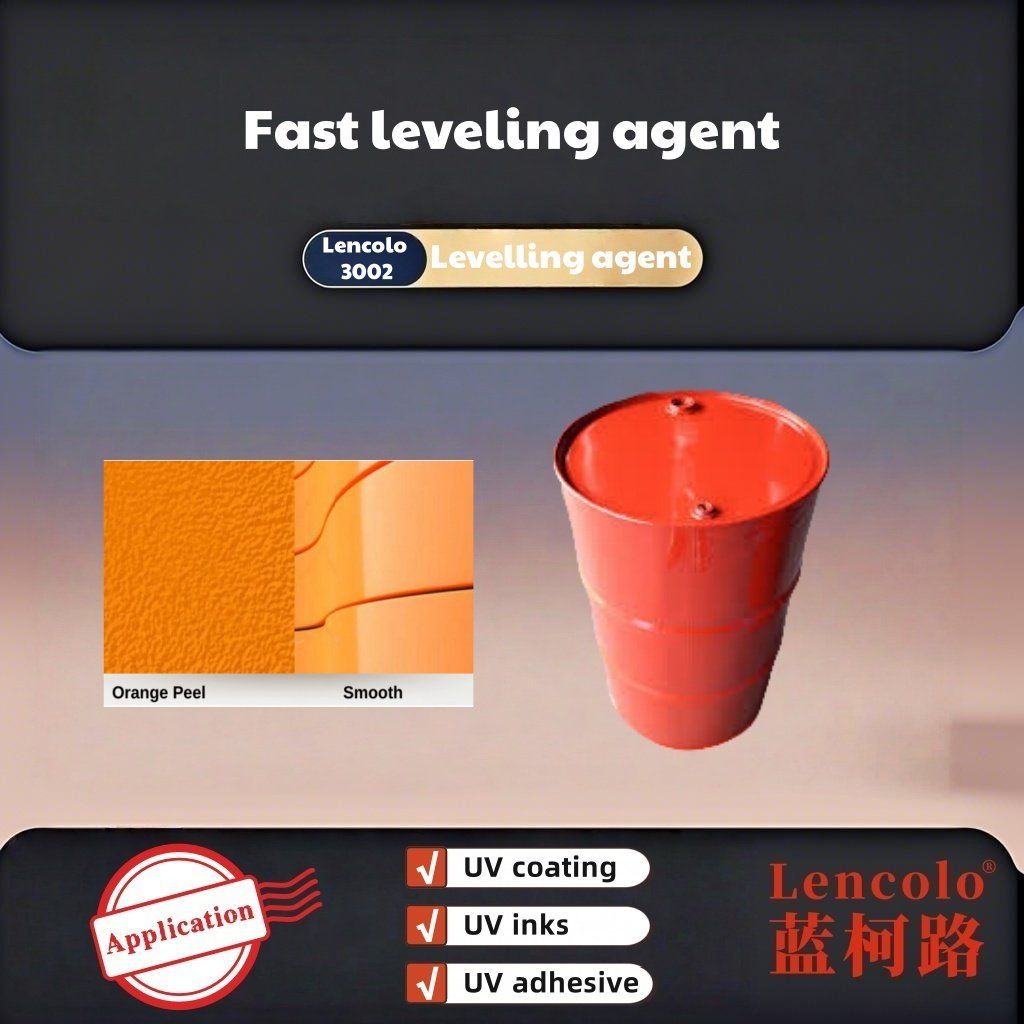
Q: What does poor leveling look like in a UV coating?
A: Poor leveling usually appears as orange peel, brush marks, roller lines, uneven gloss, surface waviness, or an inconsistent film appearance after curing. The problem can be particularly noticeable on automotive interior parts, plastic, glass, metal, and vacuum-metallized surfaces.
UV coatings are more sensitive to leveling because the film has only a limited time to flow before UV exposure rapidly increases crosslinking. If the coating does not become sufficiently uniform before curing, surface defects can become permanently fixed in the film.
Q: Should poor leveling be treated as a resin problem or an additive problem?
A: It can be either, and sometimes both. Resin viscosity, functionality, molecular structure, monomer selection, and curing speed all influence how easily a wet film flows.
A high-functionality resin may provide excellent hardness and crosslink density but can also reduce flow if the formulation becomes too viscous or cures too quickly. Therefore, simply adding more leveling agent is not always the best solution.
A better approach is to first determine whether the problem originates from the base resin and formulation rheology or from insufficient surface flow after application.
Q: Why is “fullness” important when evaluating leveling?
A: Leveling and fullness are related but not identical. Leveling describes how uniformly the wet coating flows into a smooth surface, while fullness refers more to the visual depth, film build, and overall richness of the cured coating.
A formulation may have good leveling but still produce a thin-looking or visually flat film. For applications where appearance is critical, such as automotive interiors or vacuum metallization topcoats, both properties should be evaluated together.
For this reason, Lencolo positions L-6460, a four-functional UV polyurethane resin, around high leveling and high fullness for automotive interior UV coating applications.
Q: Which UV resins can be considered when leveling and recoatability are both required?
A: Recoatability adds another constraint because a surface additive or resin that improves initial flow can sometimes affect adhesion of a subsequent layer.
L-6410 is a four-functional UV polyurethane resin positioned for high fullness and recoatability in plastic, glass, and metal coating applications. L-6460 can also be considered where high leveling and fullness are important.
For vacuum-metallized coatings, L-6300, L-6350, L-6410, and L-6460 are resin options positioned for leveling and fullness in topcoat applications. A smooth topcoat is especially important because surface defects can remain highly visible over the reflective metallized layer.
Q: When should a dedicated leveling additive be used?
A: A leveling additive becomes particularly useful when the basic resin system has acceptable viscosity and curing behavior but still shows surface-flow defects.
Lencolo 3002 is positioned as a fast leveling agent with recoatability, while Lencolo 3160 is a recoatable leveling agent with compatibility across water-based and oil-based systems. These materials can provide different options depending on the coating system and whether fast surface leveling or broader system compatibility is the priority.
However, additive dosage should be optimized through testing. Excessive surface modification can influence intercoat adhesion, compatibility, surface appearance, and other coating properties.
Q: Is wetting the same as leveling?
A: No. The two functions can overlap, but they address different stages of the coating process. Wetting primarily concerns how well a liquid coating spreads over a substrate or interacts with solid particles. Leveling concerns how the applied film becomes uniform after deposition.
This distinction is important in multi-layer systems. For example, L-6300 and L-6411 can be considered for wetting requirements in vacuum-metallization color-coat applications, while the topcoat may require a different resin strategy focused on leveling and fullness.
Q: How should a leveling problem be diagnosed before changing materials?
A: Start by checking the application viscosity, coating thickness, substrate surface, application method, flash or flow time before UV exposure, lamp conditions, and curing speed. Then compare the results after adjusting the resin, monomer, or leveling additive separately.
A useful evaluation should include orange peel, gloss uniformity, surface smoothness, fullness, adhesion, recoatability, hardness, and final curing.
The most effective leveling solution is therefore rarely a single “strong” additive. It usually comes from matching the UV resin, monomer, additive package, application conditions, and curing process to the specific substrate and surface requirement. This approach helps formulators solve the underlying cause instead of simply masking the visible defect.
https://www.lencolo37.com/
Guangdong Lencolo New Material Co., Ltd. -
AuthorPosts

- You must be logged in to reply to this topic.