- This topic is empty.
-
AuthorPosts
-
2026-11-02 at 4:29 pm #15206
Choosing the right fire protection equipment is an important part of creating a safe residential environment. Although fire sprinkler heads are relatively small components, their performance can significantly influence how effectively a sprinkler system responds to a developing fire. For homeowners, property developers, builders, fire protection contractors, and purchasing professionals, understanding what to evaluate before buying residential fire sprinkler heads can help prevent compatibility issues, unnecessary replacement costs, and installation problems.
Not all sprinkler heads are designed for the same applications. Differences in sprinkler type, temperature rating, response characteristics, water discharge performance, installation requirements, and product approvals can affect whether a particular model is suitable for a home. A product that works well in one residential setting may not meet the requirements of another building or sprinkler system.
Price is another consideration, but it should not be the only deciding factor. Buyers also need to evaluate product quality, manufacturer documentation, supplier reliability, and compliance with applicable fire protection standards. These factors are particularly important for residential construction projects where multiple sprinkler heads must meet consistent technical specifications.
This article explains the key considerations before purchasing residential fire sprinkler heads, helping buyers compare products more effectively and make informed decisions based on their project requirements.
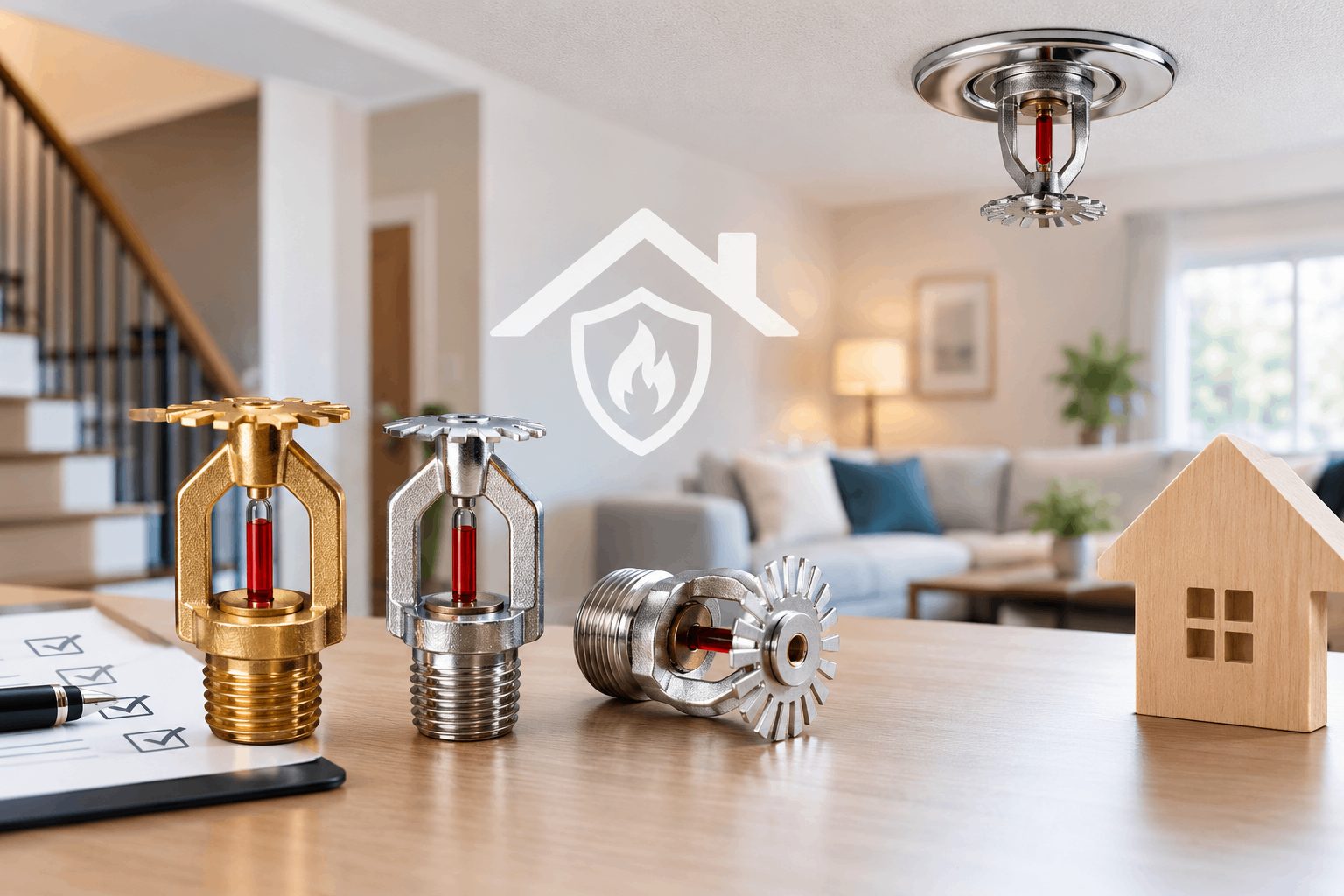
1. Identify the Type of Residential Fire Sprinkler Head You Need
The first step is to determine which type of sprinkler head is appropriate for the intended installation. Different designs are developed for different piping arrangements, ceiling configurations, and water distribution requirements.
Pendent Fire Sprinkler Heads
Pendent sprinkler heads are installed below the piping, with the deflector positioned to distribute water downward. They are commonly used in residential rooms with finished ceilings when the system design specifies this arrangement.
When buying pendent fire sprinkler heads, consider the ceiling height, installation clearance, required coverage, and compatibility with the sprinkler system. The selected model must also be approved for the intended application.
Concealed Fire Sprinkler Heads
Concealed sprinkler heads are installed above the ceiling behind a decorative cover plate. They are often considered for apartments, modern homes, and residential developments where maintaining a clean ceiling appearance is important.
However, concealed sprinkler heads have specific installation requirements. The sprinkler and cover plate must be compatible, and the cover plate must remain unobstructed so the sprinkler can operate as designed.
Buyers should check the available finishes, temperature requirements, installation dimensions, and product listing before selecting concealed models.
Upright Fire Sprinkler Heads
Upright sprinkler heads are installed with the deflector above the sprinkler body. They are commonly used in systems with exposed piping or where the approved design requires an upright configuration.
They may be suitable for certain unfinished basements, utility spaces, or other areas where exposed piping is present. Their use in a residential building must still be determined by the system design and applicable requirements.
Sidewall Fire Sprinkler Heads
Sidewall sprinkler heads are designed to distribute water from a position near a wall. They may be useful in certain rooms where ceiling-mounted arrangements are less suitable.
When comparing sidewall sprinkler heads, review the manufacturer's coverage specifications, permitted installation positions, ceiling height limitations, and obstruction requirements.
The key purchasing principle is to select sprinkler heads based on the approved system design, not simply on appearance or connection size. Different types are not automatically interchangeable.
2. Check the Applicable Fire Safety Standards
Before purchasing residential fire sprinkler heads, determine which fire protection standards and local regulations apply to the project.
Requirements may differ according to the country, building classification, sprinkler system type, and authority having jurisdiction. A sprinkler head that is suitable for one installation may not meet the requirements of another.
Understand the Relevant NFPA Standards
In the United States, several National Fire Protection Association standards may be relevant to residential sprinkler systems.
-
NFPA 13D addresses sprinkler systems in one- and two-family dwellings and manufactured homes.
-
NFPA 13R addresses certain residential occupancies, including qualifying low-rise residential buildings.
-
NFPA 13 covers sprinkler system design and installation across a broader range of applications.
These standards have different scopes, so buyers should not assume that they can be used interchangeably.
The applicable standard should be determined based on the building and project requirements, including any local amendments or additional regulations.
Confirm Product Listings and Approvals
A product listing or certification can provide evidence that a sprinkler head has been evaluated against defined requirements. Depending on the market and project specification, buyers may encounter UL Listings, FM Approvals, or other relevant product certifications.
However, not every project requires the same approvals, and a certification does not automatically establish suitability for every residential application.
Before placing an order, verify the exact model number and confirm that the listing or certification covers the intended use. Buyers should also check whether the selected product satisfies the requirements of the local authority and the approved sprinkler system design.
3. Evaluate the Temperature Rating
Temperature rating is an important factor when choosing residential fire sprinkler heads. It indicates the operating temperature classification associated with the sprinkler's heat-responsive element.
Different areas of a home may experience different ambient temperatures. A bedroom with stable indoor conditions presents a different environment from a kitchen, an area near heating equipment, or an unheated garage.
Match the Rating to the Installation Environment
A sprinkler head must have a temperature rating appropriate for the expected conditions around its installation location.
If the rating is unsuitable for the environment, the sprinkler may be more susceptible to unintended activation under elevated ambient temperatures or may not provide the response characteristics intended by the system design.
Buyers should consider nearby heat sources, expected temperature variations, and the manufacturer's recommendations before choosing a model.
Avoid Selecting a Rating Based on Assumptions
A higher temperature rating is not automatically better. The correct rating depends on the application, the sprinkler's listing, and the requirements of the system.
For example, a sprinkler installed near a heat-producing appliance may require a different rating from one installed in a typical living area. The selection should be made by a qualified fire protection professional using the applicable requirements rather than by applying a general rule to every room.
When comparing residential fire sprinkler heads, make sure the temperature rating is clearly documented and consistent with the project specifications.
4. Understand Response Characteristics
Sprinkler response characteristics influence how the heat-responsive element reacts to rising temperatures. They should be considered alongside the sprinkler's intended application and approved system design.
Residential-Specific Sprinklers
Some sprinkler heads are specifically designed and listed for residential applications. Depending on the product, their design may address the discharge characteristics and installation conditions required for the intended residential system.
Buyers should confirm that the selected sprinkler is listed for the specific application rather than relying on a general description such as "fast acting."
Quick-Response and Standard-Response Products
Quick-response and standard-response sprinklers have different thermal response characteristics. The appropriate choice depends on the applicable standard and system design.
A quick-response sprinkler is not automatically an acceptable substitute for a residential sprinkler specifically listed for a particular application. The product category, performance characteristics, and installation limitations must be verified.
When buying residential fire sprinkler heads, review the technical data sheet to confirm the response classification and intended use.
5. Review Coverage Area and Water Distribution
Coverage is one of the most important technical factors when purchasing sprinkler heads. Each model has defined installation limitations, and its ability to protect a given area depends on more than the sprinkler's physical dimensions.
Consider Room Dimensions and Ceiling Height
Room size, shape, ceiling height, and construction features all influence sprinkler placement. A long, narrow room may require a different arrangement from a square room of similar floor area.
Open-plan living spaces can also present additional design considerations because of changes in ceiling height, beams, lighting fixtures, or other architectural features.
Before ordering, ask the fire protection designer to confirm the required number of sprinkler heads and their permitted spacing based on the selected model and applicable standard.
Identify Potential Obstructions
Common obstructions include ceiling fans, pendant lights, decorative beams, cabinets, and other fixtures. Depending on their location and dimensions, these objects may interfere with the intended water distribution pattern.
The sprinkler layout should be coordinated with electrical, mechanical, and interior design plans to reduce installation conflicts.
Buyers should avoid assuming that one sprinkler model can cover every room or that increasing the number of sprinkler heads will automatically correct an unsuitable layout. Coverage must be established through a compliant system design.
6. Confirm Water Pressure, Flow, and System Compatibility
A sprinkler head operates as part of a complete fire protection system. Its performance depends on the water supply, piping arrangement, valves, fittings, and other components working together as intended.
Check Hydraulic Requirements
Different sprinkler heads have different hydraulic characteristics. The selected model must be able to deliver the required water discharge under the pressure conditions established by the system design.
A product that looks suitable or has the correct temperature rating may still be inappropriate if the system cannot meet its required flow and pressure conditions.
Before buying residential fire sprinkler heads, confirm that the model's hydraulic specifications match the design calculations.
Verify Connections and Dimensions
Connection size, thread type, installation orientation, and dimensions should be checked before ordering.
This is particularly important for replacement projects. A sprinkler head that appears physically compatible with an existing fitting may differ in its listing, temperature rating, discharge characteristics, or other critical specifications.
For replacement work, the existing system should be reviewed by a qualified professional before a different model is selected.
Consider Environmental Conditions
Some residential areas may be exposed to high humidity, corrosive substances, freezing temperatures, or potential physical damage.
Unheated garages and other spaces exposed to freezing conditions require particular attention because water in ordinary wet-pipe systems can freeze and damage the installation. The system design must address these conditions using an appropriate method.
Where environmental exposure is a concern, consult the manufacturer about suitable materials, finishes, and approved applications.
7. Compare Product Quality and Manufacturing Consistency
Product quality should be evaluated alongside certification and technical suitability. Residential fire sprinkler heads are safety-related components, so consistent manufacturing and reliable product identification are important.
Examine Technical Documentation
A professional manufacturer should provide clear information about its products, including:
-
Product model and identification
-
Temperature rating
-
Response classification
-
Connection dimensions
-
Installation orientation
-
Operating pressure and flow information
-
Coverage limitations
-
Applicable listings or certifications
-
Installation and maintenance instructions
Complete documentation helps buyers compare products based on verifiable specifications instead of relying on general promotional claims.
Ask About Quality Control
Manufacturing consistency is particularly important for builders and contractors purchasing sprinkler heads in large quantities.
Buyers may wish to understand the manufacturer's inspection procedures, traceability practices, production controls, and methods for maintaining consistent specifications.
These details can help procurement teams evaluate whether a supplier is equipped to support larger residential developments or recurring orders.
Avoid Unverified Product Claims
Descriptions such as "premium quality," "international standard," or "high performance" do not establish that a product meets the requirements of a specific installation.
Request supporting technical documents and verify the information against the applicable product listing or certification database when relevant.
8. Consider Maintenance and Replacement Requirements
A purchasing decision should account for the long-term needs of the sprinkler system, not only the initial installation.
Sprinkler heads may remain in service for many years, provided they are installed, inspected, and maintained according to applicable requirements. Their condition and replacement needs depend on the product, environmental exposure, and relevant inspection rules.
Check Maintenance Instructions
Before purchasing, review the manufacturer's guidance on inspection, handling, cleaning restrictions, and replacement.
Sprinkler heads should not be painted, modified, disassembled, or obstructed unless the applicable instructions explicitly permit a particular action. Accidental damage or unauthorized changes may affect performance.
Routine inspection should identify visible signs of corrosion, leakage, physical damage, deposits, or obstructions. Any issue should be evaluated by qualified personnel.
Confirm Replacement Availability
For residential developments and property management projects, future replacement availability can be an important consideration.
Buyers should confirm whether the manufacturer can identify products by model and specification and whether replacement products are likely to remain available. This can make future maintenance easier and reduce the risk of selecting an incompatible substitute.
If a replacement model is proposed, its suitability must be verified against the system requirements rather than assumed from a similar appearance.
Conclusion
Buying residential fire sprinkler heads requires more than comparing product appearances or unit prices. Buyers should first identify the appropriate sprinkler type, confirm compliance with applicable fire protection standards, and review temperature ratings, response characteristics, coverage requirements, and hydraulic compatibility. Product documentation, manufacturing consistency, environmental suitability, and future replacement availability also deserve attention.
For homeowners, working with a qualified fire protection professional helps ensure that the selected sprinkler heads match the property's design and regulatory requirements. For contractors, developers, and purchasing teams, evaluating a manufacturer's technical capabilities and supply reliability can help streamline procurement and reduce avoidable project issues.
Yuanqing supports fire protection product selection by helping customers evaluate sprinkler products in relation to their application requirements. By prioritizing verified specifications, appropriate product approvals, and dependable manufacturing support, buyers can make more informed purchasing decisions and contribute to the long-term reliability of residential fire protection systems.
http://www.yuanqingxiaofang.com
yuanqingxiaofang -
-
AuthorPosts

- You must be logged in to reply to this topic.