- This topic is empty.
-
AuthorPosts
-
2026-11-03 at 6:01 pm #15231
College basketball arenas are designed for more than competitive games. Throughout the year, university sports facilities may host basketball tournaments, daily‑training sessions, physical‑education classes, student activities, and even televised sporting events.
These different uses place varying demands on the lighting system.
A lighting solution that works for everyday practice may not provide the visual quality required for a competitive game. Similarly, a system designed for major televised events may consume unnecessary energy if the entire facility operates at full output every day.
So, how should universities and facility managers plan basketball arena lighting for both competition and training?
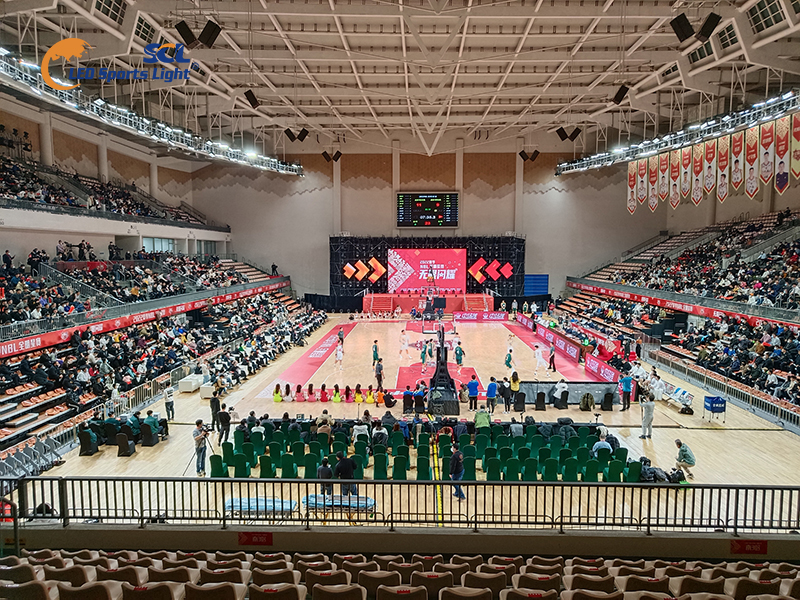
1. Understand the Different Lighting Requirements
The first step is to identify how the basketball arena will be used.
A university gymnasium may need several lighting configurations:
Daily training
Training sessions require comfortable and sufficiently uniform illumination so players can follow the ball, teammates and court boundaries. Energy efficiency and convenient operation are also important.
University‑level competitions
Competitive games require more consistent lighting across the playing surface. Players, referees and spectators all need clear visibility throughout the game.
Televised competitions
When a venue hosts HD television broadcasts, additional attention must be given to vertical illuminance, glare control, camera positions and flicker performance.
General‑purpose activities
The arena may also be used for school ceremonies, physical education classes and community events. These activities may not require the same lighting output as a professional competition.
A well-designed system should consider these operating scenarios from the beginning.
2. Horizontal Illuminance and Uniformity: The Foundation of Court Lighting
Basketball involves rapid movement, jumping, passing and shooting. Players must be able to follow the ball and react quickly across the entire court.
Horizontal illuminance refers to the quantity of light incident upon the playing surface. It is one of the fundamental parameters for evaluating basketball‑court lighting.
However, average illuminance alone is not enough.
Lighting uniformity is equally important because excessive differences between bright and dark areas can affect visual comfort and playing conditions.
A professional lighting design should evaluate:
l Average horizontal illuminance
l Minimum and maximum illuminance
l Lighting uniformity across the court
l Brightness differences between playing and surrounding areas
l Glare and visual comfort
The appropriate target values depend on the competition level, applicable lighting standards and whether television broadcasting is required.
Universities should therefore establish the intended use of the arena before selecting fixtures or determining the lighting layout.
3. Vertical Illuminance for Television Broadcasting
For university arenas hosting televised competitions, horizontal illuminance is only part of the lighting requirement.
Vertical illuminance measures the light falling on vertical surfaces, such as players’ faces and bodies. It helps cameras capture players clearly from different shooting directions.
This becomes particularly important when:
l Games are broadcast in HD
l Multiple camera positions are used
l Players move rapidly across the court
l Close-up shots are required
l The venue hosts major university or international competitions
Lighting designers should consider camera positions and broadcast requirements when determining fixture locations, aiming angles and optical distributions.
A lighting system designed only around the playing surface may not deliver the visual quality required for television production.
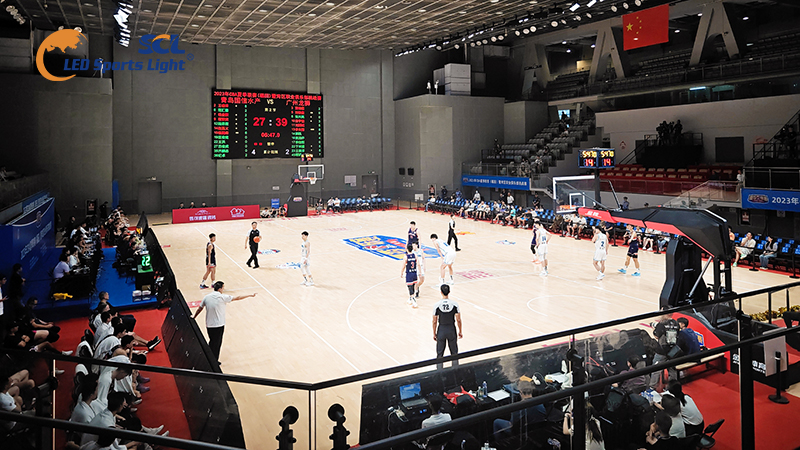
4. Glare Control for Players and Spectators
Basketball players frequently look upward when shooting, rebounding and tracking the ball.
If luminaires are poorly positioned or their optical distribution is unsuitable, bright light sources may enter players’ direct field of vision.
This can create discomfort and interfere with visual performance.
For indoor basketball arenas, glare control should consider:
l Mounting height and fixture locations
l Luminaire beam angles
l Player viewing directions
l Optical shielding and light distribution
l Spectator seating and camera positions
The objective is to provide useful illumination while minimizing excessive brightness and unwanted reflections.
Simply increasing fixture wattage does not necessarily improve the lighting experience.
5. Flexible Lighting Control for Training and Competition
One of the most practical requirements for university sports facilities is the ability to switch between different lighting modes.
A flexible lighting control system can help reduce unnecessary energy consumption while allowing the arena to meet different activity requirements.
Common lighting scenes include:
Operating mode
Main purpose
Training mode
Daily practice and sports classes
Competition mode
University and regional tournaments
Broadcast mode
Games requiring television coverage
General activity mode
Ceremonies and recreational activities
Emergency mode
Emergency lighting requirements
Depending on the project, control technologies such as 0–10V dimming, DMX512 or centralized intelligent control may be considered.
The control system should be selected according to the venue’s operating needs, equipment compatibility and integration requirements.
For universities that use their arenas throughout the day, independent lighting zones and scheduled operation can also help improve management efficiency.
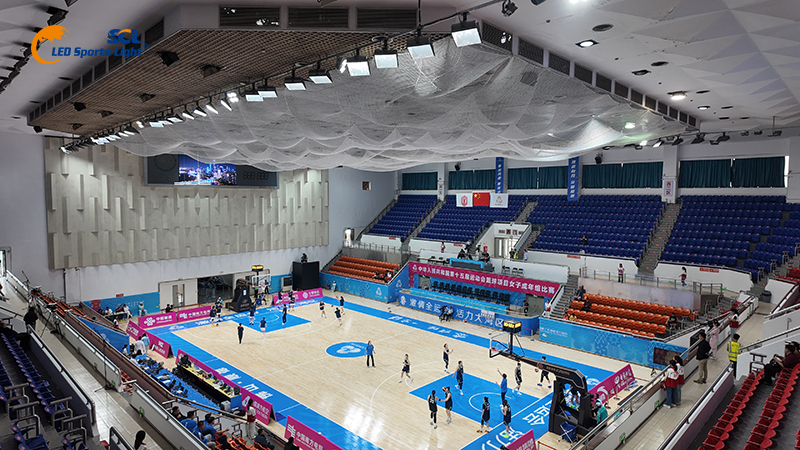
6. How to Choose LED Sport Fixtures for a University Basketball Arena
Selecting LED sports lights requires more than comparing wattage and price.
Facility managers and project designers should evaluate the following factors:
Optical distribution
The light distribution should match the court dimensions, mounting height and fixture positions. Appropriate optics help improve uniformity and reduce unwanted light.
Glare performance
Fixtures should be suitable for indoor sports applications, with optical designs that consider players’ upward viewing directions.
Thermal management
Effective heat dissipation supports stable operation and helps protect the long-term performance of LED components.
Electrical and control compatibility
The selected fixtures should work with the venue’s electrical infrastructure and intended dimming or control system.
Maintenance accessibility
Installation positions and maintenance arrangements should be considered, particularly in arenas with high ceilings.
A professional lighting simulation and site assessment can help identify the most suitable fixture configuration before installation.
7. SCL Sports Lighting: Experience in Sports and University Venues
SCL Sports Lighting provides LED sport lighting solutions for indoor and outdoor sports facilities, including basketball arenas, university gymnasiums and competition venues.
Its project experience includes several basketball facilities designed for different operating requirements.
Futian Sports Park Gymnasium, China
The venue adopted SCL Sports Lighting QDZ-300B LED sports lights for the CBA Summer League. The lighting system was designed to meet television broadcasting requirements while supporting the visual needs of players and spectators.
Shunde Sports Center, China
The project incorporates DMX512, RGBW and Wi-Fi technologies into its lighting control solution. Different operating modes support competition, spectator activities and emergency requirements.
Tangshan New Sports Center, China
For the NBL All-Star Game, SCL Sports Lighting supplied customized QDZ-600B LED sports lights with intelligent control and smart venue integration. The lighting solution was designed to meet HD television broadcasting requirements.
Beyond basketball facilities, SCL Sports Lighting has also participated in lighting projects for university venues, including Beijing University of Aeronautics and Astronautics Gymnasium and Fudan University Table Tennis Hall.
SCL Sports Lighting was the official lighting supplier for the 31st FISU World University Games, demonstrating its involvement in lighting solutions for major university sporting events.
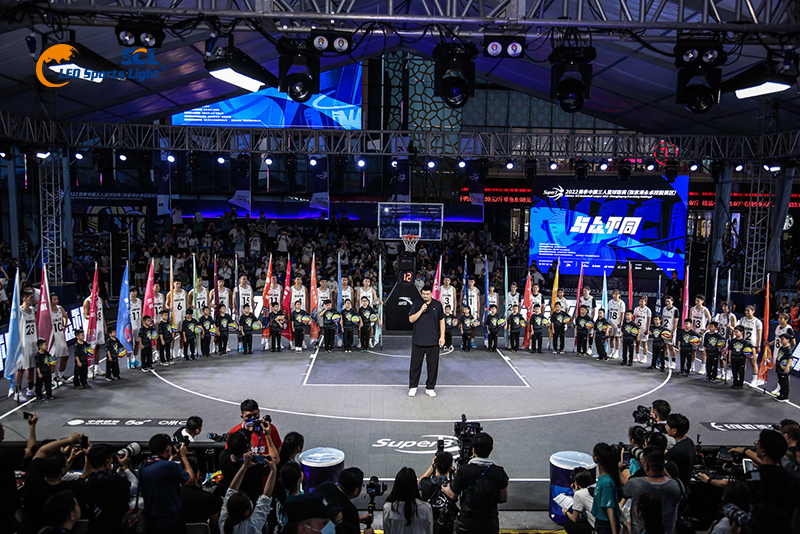
Conclusion
University basketball arena lighting should be planned around the facility’s full range of activities, not just its most important competition.
Horizontal illuminance, uniformity, vertical illuminance, glare control and flexible lighting management all contribute to a successful solution.
For universities planning a new gymnasium or upgrading an existing facility, a project-specific lighting design can help balance competition requirements, daily usability and long-term operating efficiency.
SCL Sports Lighting provides professional LED sports lighting solutions, supporting venue owners and project teams with lighting design, product selection and system planning based on their facility requirements.
https://www.stadiumlight.com/
GUANGDONG SEVEN CONTINENTS INDUSTRIAL CO., LTD -
AuthorPosts

- You must be logged in to reply to this topic.