- This topic is empty.
-
AuthorPosts
-
2026-01-07 at 6:20 pm #12881
The rapid expansion of utility-scale and distributed solar projects has shifted attention from panel efficiency alone to the mechanical systems that sustain long-term energy yield. Among these systems, the custom solar slew drive plays a decisive role in how accurately, reliably, and economically a solar tracking structure operates over decades. Rather than treating slew drives as standardized components, project developers and equipment integrators increasingly view customization as a strategic engineering choice tied directly to site conditions, lifecycle cost, and grid-level performance. In this blog post, YOJU, as high quality slewing drive for solar tracking system exporter, will share the advantages of custom solar slew drive design for precision tracking system.
Why Customization Matters in Solar Tracking Mechanisms
Solar tracking environments are far from uniform. Desert installations, coastal regions, agricultural solar farms, and high-altitude sites impose distinct mechanical and environmental stresses. A generic slew drive may function initially, but mismatches in load capacity, sealing, or control interface often surface as maintenance issues years later.
A custom solar slew drive addresses these mismatches at the design stage. Instead of adapting the tracker structure to the drive, the drive is engineered around the tracker’s geometry, wind load envelope, and motion profile. This inversion of the traditional supply approach reduces structural overdesign and improves overall system coherence.
Customization also allows designers to balance torque, backlash, and self-locking behavior in a way that aligns with the tracker’s control philosophy, whether it emphasizes high-frequency micro-adjustments or fewer, more deliberate positioning movements.
Load Profiles and Torque Mapping in Solar Slew Drive Design
One of the most overlooked aspects of slew drive selection is the difference between static, dynamic, and shock loads. In solar tracking systems, wind-induced loads often exceed gravitational loads, especially during stow and transition states.
A custom solar slew drive is engineered with a torque map that reflects real operating conditions rather than nominal ratings. Engineers analyze:
-
Peak wind moments during emergency stow
-
Cyclic fatigue loads from daily tracking motion
-
Asymmetric loads caused by uneven snow or dust accumulation
By aligning gear geometry, bearing raceway design, and housing stiffness with these load cases, a custom drive avoids excessive safety margins that increase cost and mass without improving reliability.
Structural Integration with Tracker Frames
Mechanical compatibility between the slew drive and tracker frame is critical. Bolt patterns, flange thickness, and mounting orientation directly affect load transfer and long-term alignment.
Custom solar slew drive configurations allow mounting interfaces to be tailored to the tracker’s support structure. This reduces the need for adapter plates or welded transition components, which are common sources of stress concentration and corrosion.
More importantly, integrated design improves stiffness continuity between the drive and the tracker torque tube or pedestal. This continuity minimizes micro-deflections that can accumulate into positioning errors across large arrays.
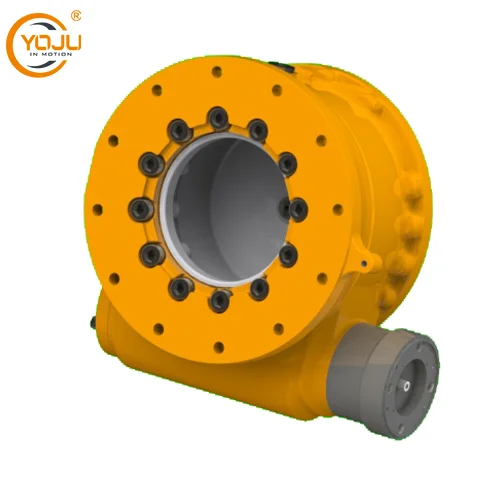
Environmental Sealing and Material Strategy
Solar installations operate in some of the harshest outdoor environments. Temperature cycling, UV exposure, humidity, sand, and salt all contribute to degradation if not addressed holistically.
Customization enables targeted material and sealing strategies, such as:
-
Housing alloys selected for thermal stability and corrosion resistance
-
Multi-stage sealing systems designed around site-specific contamination risks
-
Lubrication formulations optimized for temperature extremes rather than laboratory averages
A custom solar slew drive is therefore not just mechanically matched to the application, but environmentally tuned to its deployment context, extending service intervals and reducing unplanned downtime.
Control Interface Alignment with Tracking Algorithms
Mechanical performance and control logic are inseparable in modern solar tracking systems. Encoder resolution, motor sizing, and backlash characteristics all influence how accurately a tracker follows the sun’s path.
By customizing the slew drive, designers can align mechanical resolution with control system expectations. This includes matching gear ratios to motor torque curves and selecting bearing preloads that support smooth, low-hysteresis motion.
Such alignment reduces control compensation requirements, simplifying software logic and improving positional repeatability over the system’s operational life.
Lifecycle Cost Versus Initial Procurement Cost
A common misconception is that customization inherently increases cost. In reality, a custom solar slew drive often reduces total cost of ownership when evaluated over a 20–30 year project lifespan.
Standard drives may appear economical upfront, but indirect costs accumulate through:
-
Increased structural steel to compensate for mismatched load paths
-
Higher maintenance frequency due to inadequate sealing or lubrication
-
Energy yield losses from tracking inaccuracies
Custom solutions shift investment toward upfront engineering, yielding savings in installation efficiency, maintenance planning, and long-term energy output predictability.
Scalability Across Different Solar Project Sizes
Customization does not imply one-off production. Well-designed custom solar slew drive platforms are modular, allowing shared components across multiple tracker models while preserving application-specific interfaces.
This scalability supports both small distributed installations and multi-gigawatt utility projects. By standardizing internal architectures and varying external parameters, manufacturers achieve economies of scale without sacrificing system alignment.
For developers, this approach simplifies spare parts management and reduces qualification complexity across geographically diverse projects.
Risk Mitigation Through Design Validation
Custom designs demand rigorous validation. Finite element analysis, accelerated life testing, and field simulation are integral to ensuring that a tailored solution performs as intended.
In solar applications, validation focuses on cumulative fatigue rather than short-term overload. A custom solar slew drive is validated against decades of daily movement cycles, ensuring that bearings, gears, and seals age predictably rather than catastrophically.
This emphasis on predictable degradation supports data-driven maintenance strategies and improves bankability for large-scale projects.
Supply Chain Transparency and Technical Collaboration
Customization reshapes the supplier relationship from transactional to collaborative. Instead of selecting from a catalog, developers engage in technical dialogue that clarifies assumptions, constraints, and performance targets.
This collaboration improves documentation quality, traceability of materials, and clarity in performance guarantees. For international projects, it also simplifies certification and compliance with regional standards.
A custom solar slew drive thus becomes part of a transparent engineering chain rather than a black-box component.
Future-Oriented Design in Solar Tracking Systems
As solar tracking systems evolve toward higher automation and data integration, mechanical components must accommodate future upgrades. Customization allows design provisions for sensor integration, condition monitoring, and predictive maintenance technologies.
Rather than retrofitting these features later, a forward-looking custom solar slew drive anticipates them in its structural and interface design, protecting the project’s long-term technological relevance.
Conclusion
The value of a custom solar slew drive lies not in novelty, but in alignment—alignment with site conditions, structural design, control logic, and lifecycle expectations. As solar projects scale in size and complexity, this alignment becomes a prerequisite for reliable energy generation rather than an optional refinement.
By approaching slew drive design as a system-level decision rather than a component purchase, developers and engineers can achieve more predictable performance, lower long-term costs, and greater confidence in the mechanical foundation of their solar tracking systems.
-
-
AuthorPosts

- You must be logged in to reply to this topic.