- This topic is empty.
-
AuthorPosts
-
2026-06-12 at 7:50 pm #13761
Why ISPs Need Reliable Mini UPS for Customer Premises Equipment
Internet Service Providers face a persistent challenge in maintaining network continuity at the subscriber level. Power interruptions, voltage fluctuations, and unstable grid conditions can cause customer-side devices—routers, ONTs, modems, and gateways—to reboot repeatedly. These disruptions lead to internet downtime, increased customer complaints, remote troubleshooting pressure, and unnecessary field service calls. For ISPs deploying fiber broadband, FTTH networks, or wireless CPE solutions, ensuring uninterrupted power to customer premises equipment has become a critical service quality factor.
Traditional AC UPS systems are often too bulky, costly, or complex for residential and small office installations. What ISPs need are compact, reliable, and project-ready DC backup power solutions that match real device specifications, support mass deployment, and deliver consistent performance across diverse installation environments.
Understanding the Mini DC UPS Solution for Telecom and ISP Applications
A Mini DC UPS is a compact DC backup power device designed specifically for small network equipment such as routers, ONTs, modems, gateways, and CPE devices. Unlike conventional AC UPS systems, these solutions provide direct DC output matched to the device’s voltage and current requirements, eliminating unnecessary conversion losses and reducing installation footprint.
Telecom BBU (Battery Backup Unit) solutions represent a specialized category within this product family, engineered to meet the stringent reliability and deployment standards required by telecom operators and broadband service providers. These units integrate lithium battery packs, Battery Management System (BMS) protection, and automatic switchover capability to maintain device operation during power failures.
For ISP installation projects, the core value proposition centers on three elements: application matching, deployment simplicity, and long-term supply reliability. Rather than offering generic UPS products, specialized suppliers focus on project-based model selection that considers actual device power consumption, startup surge current, backup time targets, connector compatibility, certification requirements, and mass production feasibility.
Key Considerations for ISP OEM Mini UPS Projects
When planning large-scale backup power deployments, ISPs and system integrators must address several technical and operational factors. First, device compatibility requires careful voltage and current matching. Many network devices operate on 12V DC input, but actual working current can vary significantly between models. Standard low-power Mini UPS units may not support higher-performance gateways or advanced routers with elevated power demands. Selecting backup power based solely on the adapter label current—rather than real operating load—often results in field failures during customer testing or deployment.
Second, backup time requirements must align with realistic use cases. For residential broadband applications, ISPs typically target 2-4 hours of backup runtime to cover short power outages and voltage instability periods. This requires proper battery capacity selection while maintaining compact form factors suitable for customer premises installation.
Third, connector and cable matching is essential. Network equipment uses diverse DC barrel connectors, USB-C PD interfaces, and proprietary power inputs. A successful OEM Mini UPS project must accommodate these variations through customized cables, adapters, or modular connector designs. Suppliers who support project-based connector customization reduce deployment complexity and improve installation success rates.
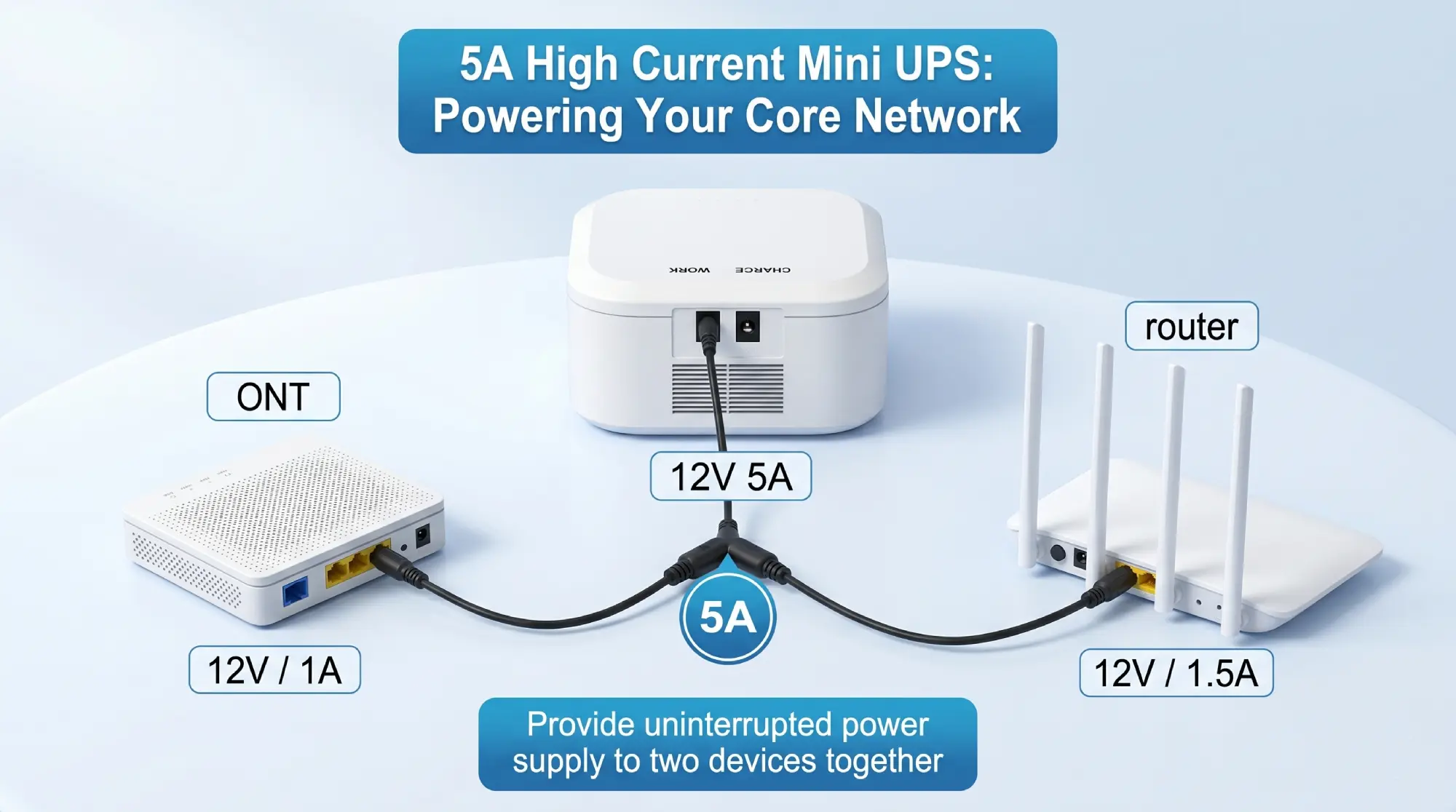
Fourth, certification and compliance documentation play a critical role in B2B procurement. ISPs require CE, FCC, RoHS compliance for market access, plus UN38.3, MSDS, and transport documentation for lithium battery shipments. Reliable OEM partners provide certification support, technical specifications, test reports, user manuals, and shipping documentation aligned with international regulatory requirements.
MYLION’s Approach to ISP Backup Power Solutions
Shanghai Mylion New Energy Co., Ltd. has developed a specialized product portfolio addressing the unique requirements of telecom, ISP, and broadband deployment projects. With over 13 years of experience in lithium battery pack development and DC backup power systems, MYLION focuses on Mini DC UPS, telecom BBU, and customized backup power solutions for global B2B customers.
The company’s product strategy centers on application matching rather than one-size-fits-all hardware supply. MYLION’s engineering team supports requirement analysis, model selection based on real device specifications, sample testing, technical confirmation, and mass production preparation. This project-oriented approach helps ISPs avoid common deployment failures caused by insufficient current capacity, connector mismatch, inadequate backup time, or incompatible installation environments.
MYLION’s 12V Standard Mini DC UPS Series—including models MU68, MU26, and MU48—addresses mainstream networking equipment deployed by ISPs and broadband operators. These compact solutions provide 12V DC output with built-in lithium battery packs, BMS protection against overcharge, over-discharge, overcurrent, and short circuit conditions. The units are designed for desktop, wall-mounted, or customer premises installation with optional connector, cable, label, packaging, and capacity customization depending on project requirements.
For higher-power applications, MYLION offers the High-Power 12V Telecom BBU Series (models MU35 and MU65) engineered for advanced gateways, WiFi gateways, and broadband CPE requiring stronger output capability. These models support higher continuous current and peak load conditions, addressing scenarios where standard low-current Mini UPS products prove insufficient.
Specialized Solutions for Modern Deployment Scenarios
As network architectures evolve, ISPs encounter new power backup challenges. FTTH deployments often face space constraints at fiber terminal locations, making traditional desktop UPS products impractical. MYLION’s Inline FTTH Mini UPS Series (model MUJ46) addresses this need with an ultra-compact inline design that connects between the original power adapter and the device, enabling clean installation in limited-space environments.
The shift toward USB-C Power Delivery in modern network equipment introduces additional complexity. Devices using USB-C PD input require backup solutions that support proper voltage negotiation and power delivery protocols. MYLION’s USB-C PD Mini UPS Series (model MUC85) provides backup power compatibility for next-generation routers, smart gateways, hubs, and terminals, helping ISPs prepare for USB-C-based power backup demand.
Some professional applications require higher DC voltages. Wireless CPE, small communication terminals, and selected access network devices may operate on 24V or 48V DC input. MYLION’s 24V/48V DC Backup Power Series (model MU248) addresses these specialized requirements with compact DC backup architecture suitable for professional telecom and industrial applications.
For customers prioritizing battery safety and service life, MYLION offers LiFePO4-based Mini UPS solutions (model ML1202AC) featuring LiFePO4 battery chemistry with longer cycle life and improved thermal stability compared to standard lithium-ion systems. This product line suits applications requiring long-term standby use and stable backup power for professional networking, security, and industrial control equipment.
OEM and Customization Support for Large-Scale Projects
Successful ISP deployment projects often require product adaptation beyond standard catalog specifications. MYLION supports OEM/ODM cooperation including private labeling, customized packaging, connector and cable matching, capacity adjustment, product appearance modification, and project-specific documentation. This flexibility enables telecom operators, broadband providers, and equipment distributors to build branded backup power solutions aligned with their specific network equipment, installation standards, and market positioning.
The company’s supply capability encompasses engineering support, sample preparation, production coordination, quality inspection, export documentation, and international logistics support for global projects. MYLION applies incoming material control, production process inspection, functional testing, and 100% outgoing inspection before shipment. Additional testing, aging verification, or charge/discharge validation can be arranged according to project requirements.
Strategic Value for ISP Deployment Programs
For ISPs evaluating backup power strategies, the choice of OEM partner significantly impacts deployment success and long-term operational costs. MYLION’s value proposition centers on application matching, technical communication, quality consistency, and project support rather than lowest-price commodity supply.
The company serves telecom operators, Internet Service Providers, broadband network companies, system integrators, network equipment distributors, and OEM/ODM project customers across Europe, North America, Latin America, Africa, the Middle East, and Asia. Products are deployed in telecom, ISP, broadband, security, industrial, and electronic equipment applications where reliable backup power, correct specification matching, and long-term supply stability are essential.
By focusing on Mini DC UPS, telecom BBU, router backup UPS, ONT backup power, gateway backup battery, and related DC backup solutions, MYLION positions itself as a specialized engineering partner for ISPs navigating the complexity of subscriber-side power continuity. The company’s 13-year track record in battery technology, combined with its B2B project orientation, makes it a suitable option for operators seeking reliable, customizable, and well-documented backup power solutions for mass deployment scenarios.
Conclusion
As broadband networks expand into regions with unstable power infrastructure and customer expectations for uninterrupted connectivity continue to rise, ISPs must address subscriber-side backup power as a strategic service quality initiative. Compact Mini DC UPS and telecom BBU solutions offer a practical path forward—provided they are properly matched to real device specifications, supported by reliable OEM partners, and backed by comprehensive project support.
Companies like MYLION, with their focus on application engineering, customization capability, certification support, and B2B supply reliability, represent the type of partner ISPs should consider when planning large-scale backup power deployments. The key lies not in selecting the cheapest generic UPS product, but in choosing a solution provider capable of delivering project-ready, well-documented, and consistently manufactured backup power systems that work reliably across thousands of customer installations.
http://www.myliontech.com
Shanghai Mylion New Energy Co.,Ltd. -
AuthorPosts

- You must be logged in to reply to this topic.