- This topic is empty.
-
AuthorPosts
-
2026-11-09 at 5:39 pm #15285
As the 2026 FAGE WTA Finals are set to take place at the Indian Wells Tennis Garden from November 8 to 15, the world’s attention is turning to the highest level of women’s professional tennis. A season-ending championship brings together elite players who have performed consistently throughout the year. It also places high expectations on every part of the tournament experience, including the playing environment.
While professional tennis lighting must always provide clear visibility and comfortable playing conditions, a major championship requires a more comprehensive approach than simply achieving a target illuminance level.
So, what makes lighting for an elite tennis tournament different from lighting for a regular tennis facility?
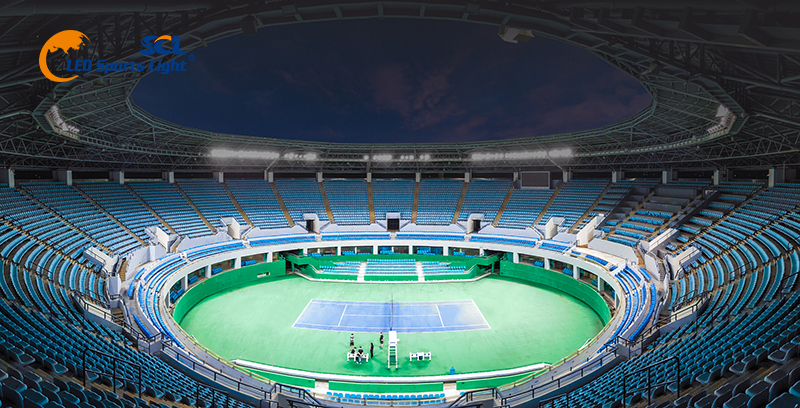
1. Consistent Lighting Across the Entire Playing Area
In professional tennis, players need to track the ball accurately from the baseline to the net, including during fast exchanges, high lobs and overhead shots.
Uneven lighting can make this more difficult. If certain areas of the court are significantly brighter or darker than others, players may experience changes in visual perception as the ball moves across the playing area.
A well-designed tennis lighting system should therefore focus on more than average illuminance. It should provide an appropriate balance of:
· Horizontal illuminance across the court surface
· Vertical illuminance for clear visibility of the ball and players
· Overall lighting uniformity
· Controlled brightness transitions between different court areas
For tournament venues with multiple courts, maintaining consistent lighting quality across the facility is also important. Players should not encounter noticeably different visual conditions when moving from one court to another.
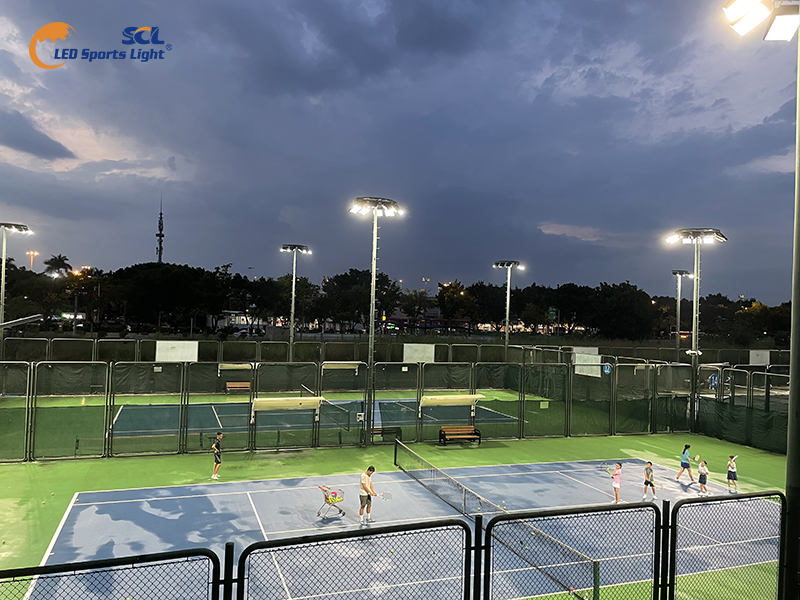
2. Glare Control Is Essential for Fast-Moving Play
Tennis involves frequent changes in ball trajectory. Players regularly look upward to follow serves, lobs and overhead shots.
If luminaires are positioned poorly or their optical distribution is not properly controlled, direct glare can interfere with a player’s ability to track the ball.
This makes glare control one of the key considerations in professional tennis lighting design.
Engineers should evaluate:
· Luminaire positioning in relation to player viewing directions
· Beam distribution and aiming angles
· The potential for direct glare during serves and overhead shots
· Brightness differences between the court and its surroundings
The objective is not simply to produce more light, but to deliver useful light where it is needed while minimizing visual discomfort.
3. Broadcast Lighting Requires More Than Bright Court Surfaces
For televised tournaments, lighting must support both the live sporting experience and the needs of broadcast cameras.
A court that appears bright to spectators does not automatically provide ideal conditions for television production.
Lighting designers may need to consider vertical illuminance on players, light distribution at different camera angles, colour rendering and the consistency of illumination throughout the playing area.
High-definition and other advanced broadcast formats can place additional demands on the lighting system. The final design should be developed around the event’s actual broadcast specifications rather than relying on a single general lux target.
This is particularly important when a venue is expected to host different levels of competition over its lifetime.
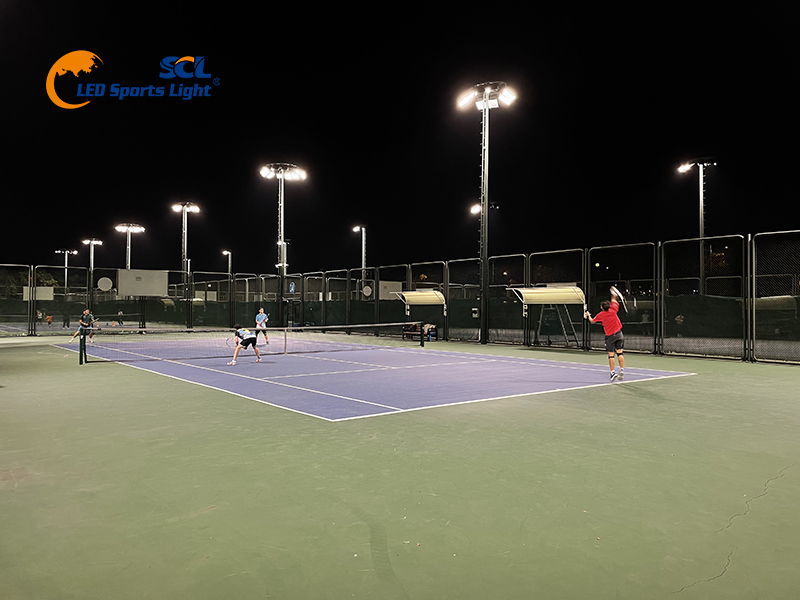
4. Outdoor Tennis Venues Need to Account for Environmental Conditions
Outdoor tennis lighting presents additional design challenges.
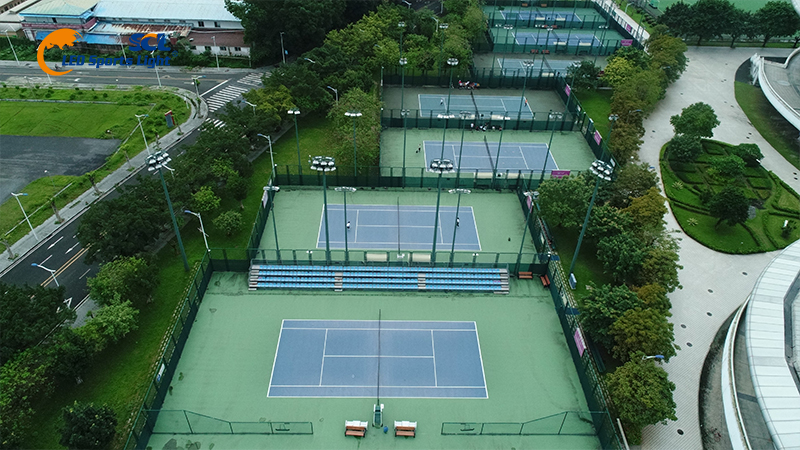
The layout of lighting poles, surrounding buildings, trees and other structures can affect how light reaches the court. Designers must also consider the impact of weather exposure and the long-term operating environment.
A suitable outdoor system should take into account:
· Pole positions and mounting heights
· Luminaire distribution and aiming directions
· Weather protection and equipment durability
· Light spill beyond the playing area
· Maintenance access and future replacement requirements
These factors should be evaluated together during the design stage. Simply increasing fixture power is not a reliable solution for poor light coverage and cannot resolve excessive glare — in fact, it often aggravates glare issues.
5. A Professional Lighting Design Starts with the Venue and Event Requirements
There is no single lighting configuration that works for every tennis venue.
A community tennis court, a training centre and an international tournament facility may have very different requirements. Even among professional venues, the appropriate solution depends on court dimensions, mounting conditions, competition level, broadcast needs and operating schedules.
A professional design process should begin by collecting accurate site information and identifying the intended use of the venue.
Lighting simulation can then help engineers evaluate illuminance distribution, uniformity, glare‑index performance and potential light spill before installation.
After installation, on-site measurements and commissioning checks are important to confirm that the completed system performs as intended.
6. Experience with Real Tennis Projects Matters
Technical specifications are important, but real project experience also helps demonstrate whether a lighting supplier understands the practical challenges of sports venues.
SCL Sports Lighting has experience in tennis venue lighting projects, including the Guangdong Olympic Tennis Center and Sichuan International Tennis Center.
At the Guangdong Olympic Tennis Center, the project data provided for the lighting system records an average illuminance above 2,000 lux, a U2 uniformity value of 0.80 and a glare rating of GR≤23.
These figures relate specifically to this project and should not be treated as universal requirements for every tennis tournament. They illustrate why lighting performance needs to be evaluated through multiple indicators rather than average illuminance alone.
SCL Sports Lighting also participated in lighting projects associated with major university and professional sporting venues, bringing practical project experience to the planning and implementation of sports lighting systems.
Conclusion
Lighting for a season-ending tennis championship is not simply about installing more powerful luminaires. It requires a coordinated approach to visibility, uniformity, glare control, broadcast performance, environmental conditions and long-term venue operation.
For tournament organizers and venue owners, the most effective solution is one developed around the actual competition requirements and site conditions.
A professionally designed tennis lighting system should help players focus on the game, give spectators a comfortable viewing experience and provide a reliable visual environment for broadcast production.
https://www.stadiumlight.com/
GUANGDONG SEVEN CONTINENTS INDUSTRIAL CO., LTD -
AuthorPosts

- You must be logged in to reply to this topic.