- This topic is empty.
-
AuthorPosts
-
2026-11-23 at 9:50 pm #15466
Understanding Creepage Distance in Pollution Degree 3 Environments
Creepage distance is one of the most critical design parameters for any busbar insulator or standoff operating in power distribution infrastructure. It defines the shortest path along the surface of an insulating material between two conductive parts, and it governs how resistant that surface is to tracking failure under contamination and humidity. For engineers specifying components for Pollution Degree 3 (PD3) environments — industrial settings where conductive pollution combined with condensation is expected — creepage distance calculation becomes a decisive factor in panel reliability and long-term safety.
Yueqing City Duwai Electric Co., Ltd., operating under the brand DOWE Electric (also referenced as DUWAI), has built its product architecture around this exact engineering challenge. As a specialized research, development, and high-precision manufacturing enterprise dedicated to electrical insulation systems and busbar supports for global power distribution infrastructure, DOWE approaches creepage distance not as an isolated number but as part of an integrated dielectric, thermal, and mechanical system.
Why PD3 Conditions Demand Extended Creepage Paths
In Pollution Degree 3 environments, surfaces are subject to conductive pollution that becomes active when moisture is present. Without adequate surface geometry, this condition accelerates carbonized tracking paths across an insulator’s body, eventually leading to flashover between live busbars and grounded backplates. This risk is compounded in high-voltage DC solar and battery systems, where DC arcing lacks a natural zero-crossing point, creating continuous surface tracking risk rather than the periodic interruption seen in AC systems.
DOWE’s SM Series standoff insulator directly addresses this scenario. Designed for standard low-voltage switchgear (LVSG), distribution panelboards, and motor control center (MCC) cabinets, the SM Series uses a conical ribbed standoff geometry in which concentric aerodynamic fins increase the effective surface creepage path by 35% to 60% without increasing the vertical installation height. These aerodynamic fin skirts are specifically engineered to extend the creepage path for Pollution Degree 3 industrial environments, allowing panel builders to meet creepage requirements within the same physical footprint rather than resorting to taller, bulkier components.
Material Science Behind Creepage Performance
Extending the physical creepage path is only part of the equation. The material itself must resist the formation of conductive carbon tracks once a pollution layer becomes active. DOWE addresses this through a Comparative Tracking Index (CTI) of 600V or higher across its insulation systems, which places the material in Material Group I — the classification associated with the highest resistance to conductive carbon tracking. This CTI rating is a foundational property shared across the company’s low-voltage standoff insulator series, including the SM Series, SB / JYZ Series, and related product lines.
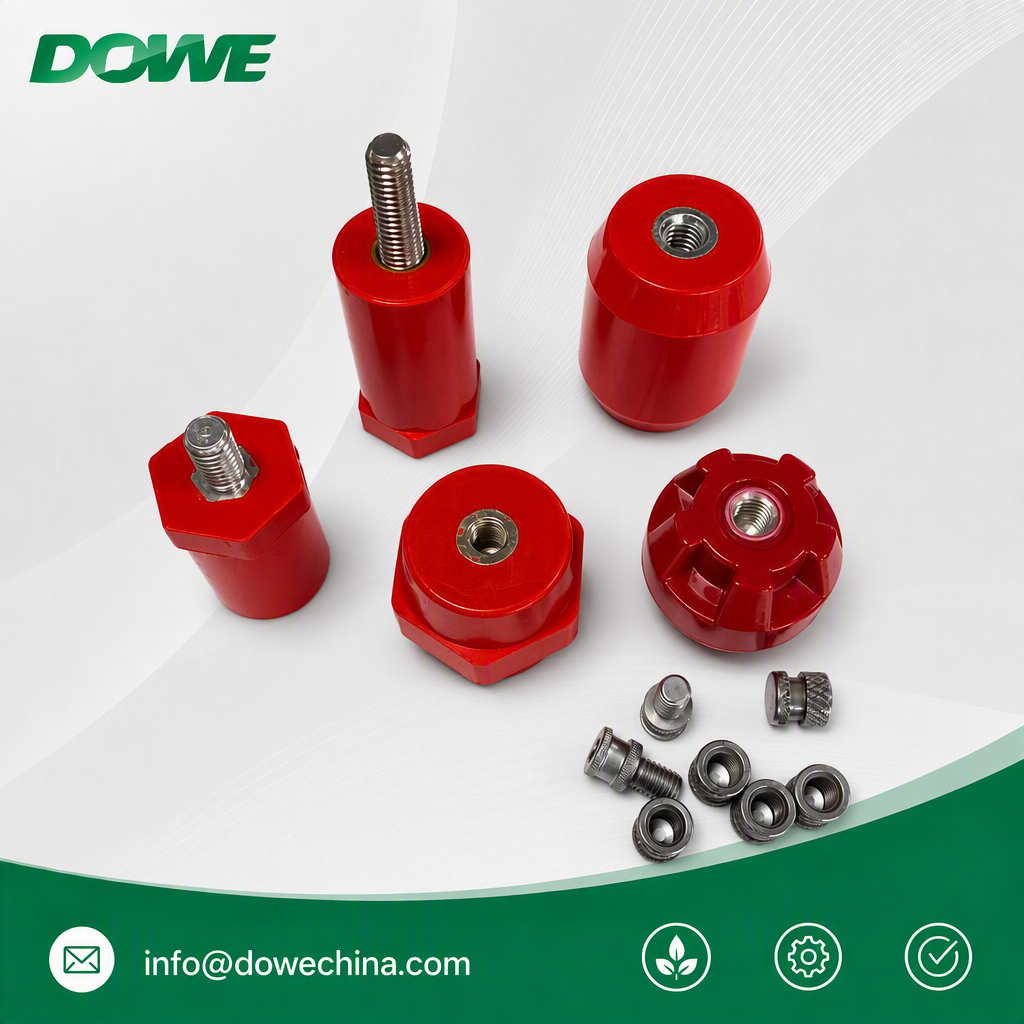
Beyond tracking resistance, DOWE’s composite formulations are engineered with isotropic mechanical properties, precision mold shrinkage control, and arc resistance, all of which support stable creepage performance over the component’s operating life. The company’s high-grade BMC construction used in the SM Series, for example, pairs the CTI 600V rating with the ribbed geometry to deliver a standoff insulator purpose-built for creepage-sensitive applications.
Dielectric and Thermal Properties That Support Creepage Integrity
A creepage distance calculation does not exist in isolation from the insulator’s broader dielectric and thermal performance. DOWE’s engineering metrics illustrate how these properties work together:
- Low-voltage dielectric withstand of 3,500V AC (50Hz, 1 minute) without puncture or flashover
- Surge impulse margin that withstands 1.2/50 μs impulse overvoltage up to 8kV, corresponding to Overvoltage Category IV per IEC 60664-1
- Heat Deflection Temperature (HDT) that maintains structural rigidity under 1.8 MPa flexural load up to +180°C
- Operating temperature endurance from -40°C to +140°C, which is particularly relevant for new energy applications where thermal cycling can affect surface integrity over time
- Dielectric loss angle tan δ no greater than 0.005 at 20°C
These figures are governed under recognized frameworks including IEC 61439-1/2, IEC 60664-1, IEC 60273, IEC 60071, and IEC 60815 — the standards family most directly connected to creepage and clearance distance determination in low-voltage switchgear and controlgear assemblies. DOWE’s compliance with these standards means that its creepage-extending geometries, such as the SM Series fin skirts, are developed with direct reference to the same framework engineers use when performing their own creepage distance calculations.
Flame Retardancy as a Companion to Creepage Safety
Even with carefully calculated creepage distances, enclosed switchgear environments require that any eventual arc fault not propagate fire risk. DOWE’s materials carry UL 94-V0 self-extinguishing flame retardancy, with afterflame time t1 + t2 no greater than 8 seconds and zero flaming drips. This property is paired with a UL 746B Relative Thermal Index (RTI) of 130°C for electrical and mechanical properties, giving panel builders a materials package where creepage geometry, tracking resistance, and fire safety are addressed together rather than as separate specifications.
Medium-Voltage Creepage Considerations
For applications above standard low-voltage thresholds, DOWE’s DW Series medium-voltage post insulator extends creepage principles into the 3.6 kV to 12 kV AC range, using a DMC/BMC/SMC composite material designed for elevated creepage performance in clean indoor switchgear and secondary distribution substations. The EL MV Series, a vacuum-cast epoxy resin insulator for 3.6 kV to 7.2 kV AC, takes a different but complementary approach: its hydrophobic surface prevents moisture film continuity — a key factor in PD3-type conditions — while its void-free monolithic casting controls internal partial discharge to less than 5 pC at 1.1 Um, and its volume resistivity exceeds 10^14 Ω·cm even under extreme condensation.
A Documentation-Ready Approach for Panel Builders
For panel builders performing their own creepage distance calculations as part of Design Verification under IEC 61439, DOWE provides third-party SGS type test reports, enabling documentation of insulation performance without requiring independent destructive testing. Combined with RoHS and REACH compliance and CE clearance, this allows creepage-critical components sourced from DOWE to move efficiently through European and North American market entry processes.
Conclusion
Creepage distance calculation for PD3 busbar insulators is not a single formula but an integrated outcome of geometry, material science, dielectric strength, and flame safety. Yueqing City Duwai Electric Co., Ltd., through its DOWE Electric brand, engineers each of these dimensions into its SM Series, SB / JYZ Series, DW Series, and EL MV Series product lines, giving engineers a documented, standards-aligned foundation for specifying insulation systems in pollution-prone, high-stress power distribution environments.
http://www.busbarinsulator.com
Yueqing City DUWAI Electric Co.,LTD -
AuthorPosts

- You must be logged in to reply to this topic.