- This topic is empty.
-
AuthorPosts
-
2026-09-04 at 3:46 pm #14607
Understanding the Real Problem Behind Router-Plus-ONT Power Loss
Any installer or network engineer who has managed a combined router and ONT (Optical Network Terminal) setup knows the frustration of short power outages, voltage drops, or unstable grid conditions causing devices to reboot or lose service. This is a widely recognized pain point in telecom, ISP, broadband, and fiber networking environments: network equipment such as routers, modems, and ONTs often lose connectivity during brief interruptions, and improper backup power selection—regarding voltage, current, peak load, or connectors—can lead to outright application failure.
For professional installers managing a router plus ONT installation, the challenge is not simply "adding a battery." It is selecting a backup power solution matched precisely to each device’s electrical characteristics while accounting for two devices drawing power simultaneously from a single installation point.
Why Voltage, Current, and Connector Matching Come First
Before any backup power product is selected, the underlying electrical profile of the installation must be evaluated. According to the operational approach used by Shanghai Mylion New Energy Co., Ltd. (brand: MYLION), solutions should be evaluated based on real device voltage, working current, peak/startup behavior, and installation environment, followed by technical confirmation and connector/cable matching to reduce selection errors. This sequence—assessing electrical parameters first, then confirming physical compatibility—reflects the core logic behind avoiding mismatched deployments in the field.
This matters directly for router-plus-ONT setups because the two devices frequently do not share identical voltage or current requirements, and a backup solution designed for a single device may not accommodate both loads reliably.
Matching Product Architecture to Combined Installations
MYLION‘s product portfolio is organized into distinct series, each addressing a different electrical profile relevant to broadband and CPE deployments.
AC-Input Dual Output Series for Combined ONT + Router Setups
The ML1202AC is positioned specifically as an AC-input dual 12V LiFePO4 UPS, designed for managing two separate 12V devices from a single AC wall outlet—a scenario that directly matches ONT + Router combined installations. Its differentiated value lies in simplified deployment: a dual output configuration that eliminates the need for an external DC adapter. Key specifications include LiFePO4 battery chemistry, 100–240V AC input, dual output through two 12V DC ports rated at 2A each (24W total system limit), and 25.6Wh battery energy. For installers dealing with two 12V-class devices at one site, this series addresses the practical need for a single backup unit rather than two separate systems.
12V Standard and Long-Runtime Series for Individual Device Backup
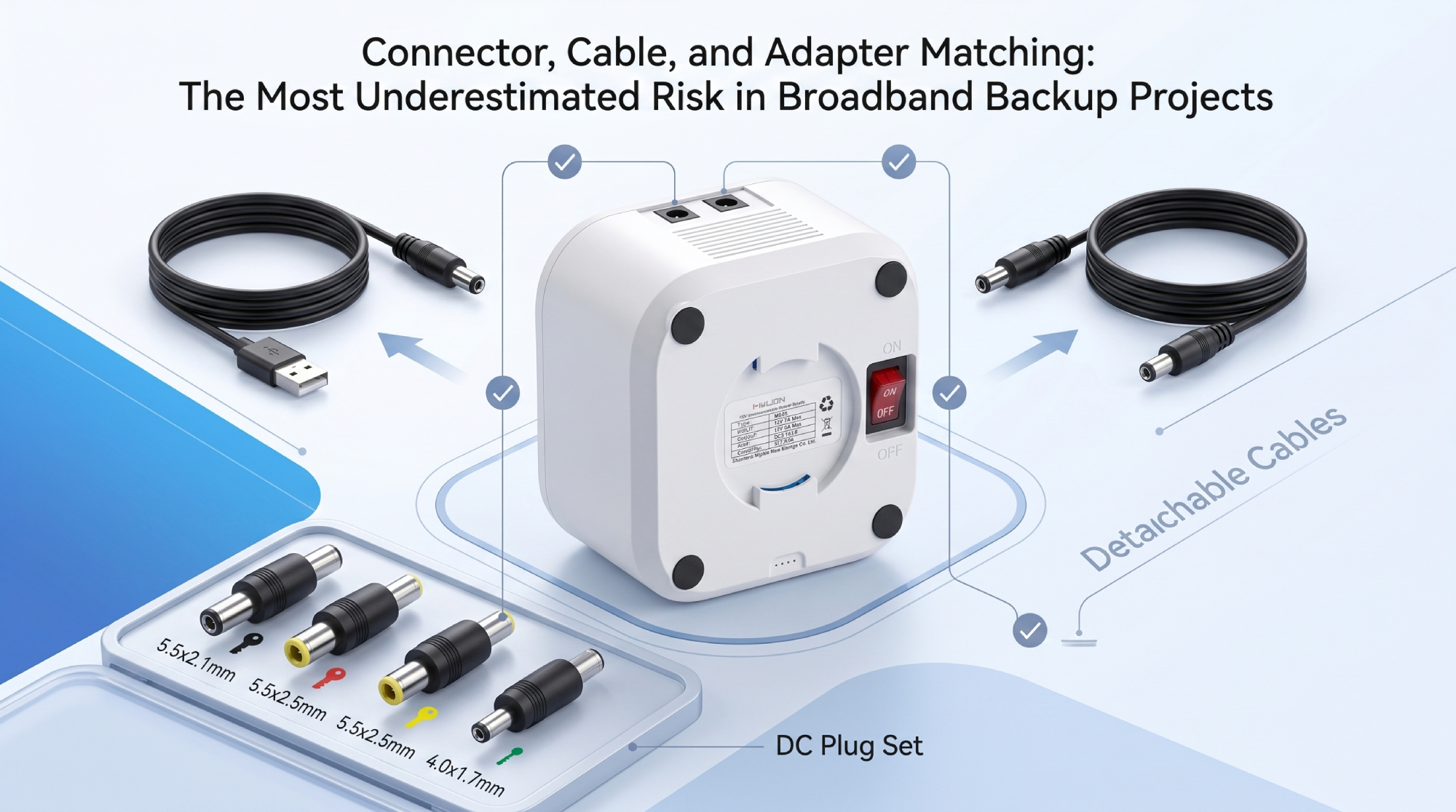
Where a router and an ONT are powered separately, or where only one device requires backup, the 12V Standard Series (MU26W, MU48W, MU68W) and 12V Long-Runtime Series (MU635W / MU635L) offer graduated capacity options. The MU26W, for example, supports 2.5A continuous / 3A maximum 12V DC output with 18.72Wh battery energy and DC5521 input / DC5525 output connectors—illustrating why connector confirmation is a necessary step, since mismatched DC connector types are a common field issue. The MU635W / MU635L extends this to 75.6Wh for longer backup duration in residential or remote-area outages.
12V High-Power Series for Higher-Load CPE
Some routers or gateways exceed standard current thresholds, particularly high-performance WiFi equipment or storage-integrated gateways. The MU65W addresses this with 4A continuous / 5A maximum (60W total) output and 56.16Wh battery energy, supporting 12V DC input up to 6A. The MU35W / MU35L combines this high-output capability with extended 75.6Wh capacity for professional gateways requiring both peak current and long backup time.
12V + USB Multi-Output Series for Mixed Device Needs
In installations where a router must be backed up alongside a USB-powered accessory, the MUJ46 and MUJ435 provide simultaneous 12V DC and 5V USB-A/USB-C outputs within an 18W maximum total output limit—relevant for SOHO (small office/home office) configurations where multiple device types share one backup source.
Technical Foundation and Compliance Behind the Product Line
Shanghai Mylion New Energy Co., Ltd. brings 13+ years of experience in Lithium Battery technology and 10+ years of experience in Mini UPS development to its product design. This background underpins the company’s specialization in Mini DC UPS technical content and ISP/broadband backup power applications, with a portfolio covering 12V DC systems up to 60W, LiFePO4 chemistry integration, and emerging USB-C PD 100W input/65W output capabilities under development, such as the MUC85 and MU248 for future higher-voltage and USB-C PD scenarios.
On compliance, products carry model-specific UN38.3 and MSDS certifications, reflecting adherence to lithium battery transport documentation requirements—an important consideration for B2B buyers sourcing across global supply chains.
Service Support for Project-Based Selection
Selecting backup power for a combined router-and-ONT deployment is rarely a single-unit decision at scale; it typically involves project-level evaluation. MYLION operates as a B2B backup power partner and OEM/ODM project partner, offering requirement analysis, model matching, sample testing support, connector/cable matching, private labeling, and documentation coordination. This service scope is designed for telecom operators, Internet Service Providers, system integrators, distributors, and brand owners evaluating backup power at the pilot or mass-production stage, with delivery capability spanning managed pilot evaluation and mass-production preparation.
Practical Takeaways for Choosing Backup Power
For anyone evaluating backup power for a router plus ONT installation, the selection sequence matters more than the product name:
- Confirm real device voltage and working current for both the router and the ONT before shortlisting any UPS model.
- Account for peak or startup current behavior, since steady-state and startup loads can differ.
- Match connectors and cables explicitly—as seen with the DC5521/DC5525 configuration on the MU26W—to avoid physical incompatibility.
- Consider whether a single dual-output unit (such as the ML1202AC) or two separate units better fits the installation footprint and outlet availability.
- Verify compatibility with platform types, since MYLION’s compatibility spans routers, ONTs, ONUs, modems, gateways, CPE devices, and security/CCTV equipment, subject to electrical verification.
Following this evaluation sequence—rather than selecting a UPS based on power rating alone—reflects the approach Shanghai Mylion New Energy Co., Ltd. applies across its Mini UPS and DC backup power solutions, supporting more reliable DC backup deployment for professional project customers in telecom, ISP, broadband, and security applications.
http://www.myliontech.com
Shanghai Mylion New Energy Co.,Ltd. -
AuthorPosts

- You must be logged in to reply to this topic.