- This topic is empty.
-
AuthorPosts
-
2026-11-11 at 12:57 pm #15310
Industry Background and the Problem of Unreliable Backup Power
Network equipment such as routers, modems, and ONTs are expected to stay online continuously, yet short power outages, voltage drops, or unstable grid conditions frequently cause these devices to reboot or lose service. For telecom operators, Internet Service Providers (ISPs), broadband network companies, fiber network operators, and system integrators, this is more than an inconvenience—it directly affects service continuity for subscribers. A less visible but equally damaging problem is improper UPS selection: mismatched voltage, working current, peak load tolerance, or connector type can lead to outright application failure even when a backup unit is installed.
Addressing this gap requires more than simply supplying a battery pack; it requires evaluating a device’s real-world electrical behavior before recommending a solution. Shanghai Mylion New Energy Co., Ltd., operating under the brand MYLION, has positioned itself as a global B2B provider of Mini UPS products, DC backup power solutions, and project support for telecom, ISP, broadband, and security applications. With 13+ years of experience in Lithium Battery technology and 10+ years of experience in Mini UPS development, the company’s background reflects the kind of specialized, device-level knowledge that this category of industrial problem demands.
Authoritative Analysis: Why Electrical Matching Determines Backup Reliability
Necessity: Backup power for network-premises equipment cannot be treated as a generic accessory. Because routers, modems, ONTs, ONUs, gateways, CPE devices, and security/CCTV equipment each draw different continuous and peak currents, a UPS that is undersized for startup or peak load will fail precisely during the outage event it was meant to cover.
Principle Logic: MYLION’s approach centers on evaluating solutions based on real device voltage, working current, peak/startup behavior, and installation environment. This is paired with technical confirmation and connector/cable matching to reduce selection errors—an approach that treats electrical compatibility, not just battery capacity, as the primary design variable.
Standard Reference: The company’s portfolio illustrates this logic in practice. The 12V Standard Series (MU26W, MU48W, MU68W) supports 2.5A continuous / 3A maximum output for compatible standard loads, while the 12V High-Power Series (MU65W) and 12V High-Power Long-Runtime Series (MU35W/MU35L) step up to 4A continuous / 5A maximum output (60W total) for high-load CPE or gateways that exceed standard 2.5A thresholds. Battery energy across the lineup ranges from 18.72Wh in the entry-level MU26W up to 75.6Wh in the MU635W/MU635L and MU35W/MU35L long-runtime models, giving project teams a documented basis for matching capacity to outage duration requirements. Relevant certifications, including UN38.3 and MSDS (both model-specific), further anchor these products within recognized compliance frameworks for lithium battery transport and documentation.
Solution Path: Rather than offering a single fixed specification, MYLION structures its catalog around distinct electrical profiles—standard output, long-runtime, high-power, high-power long-runtime, multi-output, and AC-input dual output—so that the selection process starts from the device’s actual requirements rather than from a one-size-fits-all product.
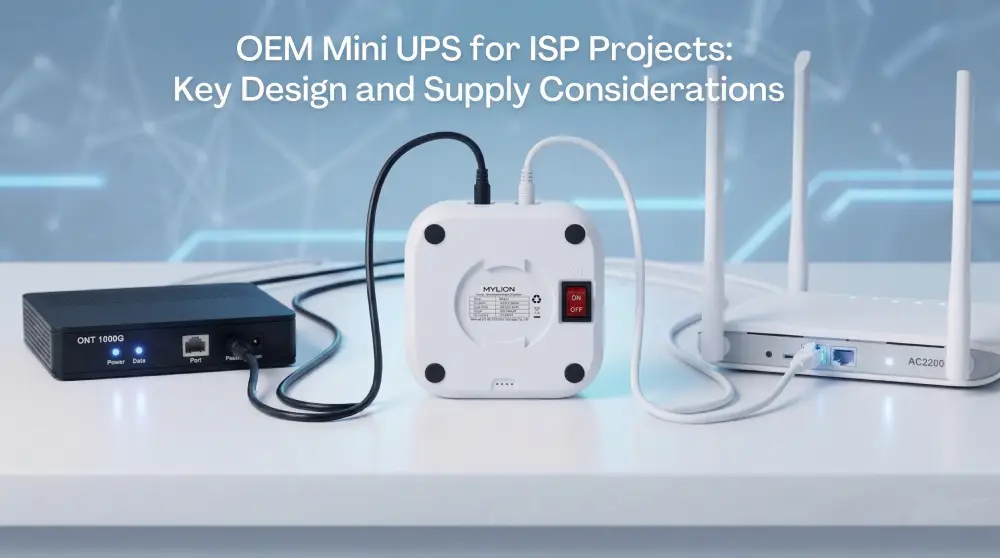
Deep Insights: Where Backup Power Technology Is Heading
Several trends emerge from MYLION’s current and in-development product directions. First, multi-output demand is growing: the 12V + USB Multi-Output Series (MUJ46, MUJ435) reflects the reality that a single installation site often needs to power both a router and a USB-connected accessory simultaneously, within an 18W system limit. Second, AC-to-DC consolidation is emerging as a deployment simplification trend—the ML1202AC, an AC-input dual 12V LiFePO4 UPS supporting 100–240V AC input and two 12V DC ports (2A each, 24W total), allows two separate 12V devices to be managed from a single AC wall outlet without an external DC adapter.
Looking forward, the company’s project-evaluation directions point toward higher-voltage and higher-power requirements. The MUC85, a USB-C PD Mini UPS under development, targets modern WiFi 6/7 devices requiring USB-C Power Delivery, with input up to 100W and dual USB-C outputs (65W and 30W respectively) alongside 92.16Wh battery energy. The MU248, a 24V/48V telecom backup direction also under development, is designed for higher-voltage wireless CPE and radio bridge equipment, with independent 24V (3A) and 48V (1A) outputs under a 100W system limit and 102.4Wh battery energy using LiFePO4 chemistry. These development directions signal that as network-edge equipment grows more power-dense and voltage-diverse, backup power selection will need to account for an expanding range of input/output standards rather than a single DC voltage class.
A standardization implication follows: as device ecosystems diversify, documentation coordination, connector/cable matching, and model-specific compliance (such as UN38.3 and MSDS) become more central to successful deployment, not peripheral details.
Company Value: Supporting Reliable Deployment at the Project Level
MYLION’s stated value proposition is to support more reliable DC backup deployment and reduce avoidable selection risks for professional project customers. This is delivered through B2B project support, OEM/ODM services, and sample validation, with a service scope spanning requirement analysis, model matching, sample testing support, connector/cable matching, private labeling, and documentation coordination. The company also manages pilot evaluation and mass-production preparation, positioning it as a partner that can carry a project from initial technical assessment through to scaled delivery.
Its compatibility coverage—spanning routers, ONTs, ONUs, modems, gateways, CPE devices, and security/CCTV equipment, subject to electrical verification—combined with a 10-product portfolio organized by electrical profile rather than generic capacity alone, demonstrates an engineering-first approach to a problem that is often treated superficially elsewhere in the market. Pricing is handled through custom enterprise and project-based quotes, and after-sales support includes technical evaluation, model matching, and project-specific documentation coordination, reinforcing that the relationship extends beyond the point of sale.
Conclusion and Recommendations for Industry Decision-Makers
Backup power failures at the network edge are frequently traceable not to battery quality but to mismatched electrical specifications and overlooked connector or documentation requirements. For telecom operators, ISPs, broadband network companies, fiber network operators, and system integrators, the practical recommendation is to treat UPS selection as a device-specific engineering task: confirm real voltage, working current, and peak/startup behavior before finalizing a model, and verify connector and cable compatibility alongside battery capacity. Organizations evaluating OEM/ODM partners for Mini UPS and DC backup power should also weigh a supplier’s documented range of electrical profiles, compliance support (such as UN38.3 and MSDS), and project-level services like sample validation and pilot evaluation. MYLION’s structured approach—spanning standard, long-runtime, high-power, multi-output, and AC-input product lines, alongside USB-C PD and higher-voltage directions under development—illustrates how aligning product specification with actual device behavior can reduce the selection errors that most commonly undermine backup power reliability in telecom, ISP, broadband, and security deployments.
http://www.myliontech.com
Shanghai Mylion New Energy Co.,Ltd. -
AuthorPosts

- You must be logged in to reply to this topic.